
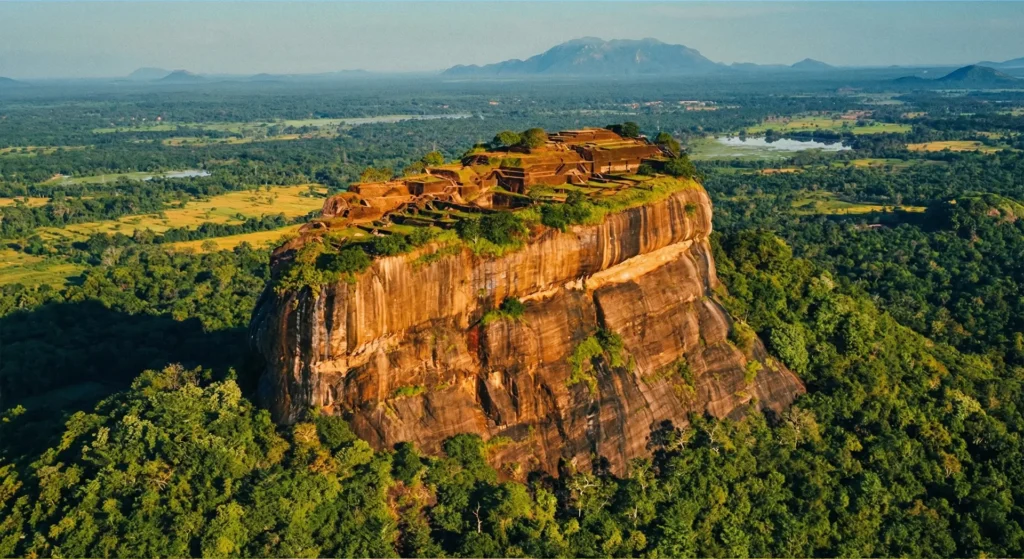
Rising nearly 200 metres above the surrounding jungle, Sigiriya is the kind of place that makes you question how ancient civilisations accomplished what they did. In the fifth century AD, King Kashyapa I transformed this massive granite monolith into a fortified royal palace — complete with landscaped gardens, decorated walls, a throne room at the summit, and a colossal lion gateway carved into the living rock. Today, this UNESCO World Heritage Site stands as one of the most remarkable archaeological monuments in the world and the single most iconic landmark in Sri Lanka.
Climbing Sigiriya is not just a historical excursion — it is a genuine adventure. The ascent takes you through water gardens that still function after 1,500 years, past a gallery of exquisite frescoes painted on the rock face, along a mirror wall inscribed with ancient graffiti, through the massive lion’s paw entrance, and finally up a series of steep metal staircases to the summit. What awaits at the top is a flat plateau roughly 1.6 hectares in size, where the foundations of Kashyapa’s sky palace and an infinity-edge swimming pool carved from bedrock overlook 360 degrees of unbroken jungle stretching to the horizon.
The History Behind the Rock
The story of Sigiriya is a tale of ambition, paranoia, and fratricidal conflict worthy of Shakespeare. In 477 AD, Prince Kashyapa seized the throne by killing his father, King Dhatusena, and driving his brother Moggallana into exile in India. Fearing his brother’s inevitable return with an army, Kashyapa abandoned the traditional capital of Anuradhapura and retreated to the impregnable rock of Sigiriya, where he spent eighteen years building one of the most extraordinary palaces the ancient world had ever seen.
When Moggallana finally returned in 495 AD, the decisive battle was fought on the plains below. Kashyapa, riding his war elephant forward to gain tactical advantage, was misread by his own army as retreating. His troops broke ranks, and the king — abandoned and defeated — took his own life. Moggallana reclaimed the throne and converted Sigiriya into a Buddhist monastery, which it remained for centuries until the jungle reclaimed it.
The site was rediscovered by British colonial officers in the nineteenth century and has since been extensively studied and partially restored. In 1982, UNESCO designated Sigiriya a World Heritage Site, recognising it as a masterpiece of ancient urban planning, hydraulic engineering, and artistic achievement.
The Climb — What to Expect
The climb to the summit involves roughly 1,200 steps and takes most visitors between 60 and 90 minutes at a comfortable pace. The route is well-maintained and clearly marked, with rest points and sheltered areas along the way. Here is what you will encounter at each stage of the ascent.
The Water Gardens
The approach to the rock passes through elaborate landscaped gardens that are remarkable feats of hydraulic engineering. Symmetrical water features, fountains (which still function during the rainy season), and bathing pools demonstrate a level of garden design sophistication that was centuries ahead of its time in Asia. Take time to appreciate these before the climb — most visitors rush through, but the gardens are extraordinary in their own right.
The Frescoes (Sigiriya Maidens)
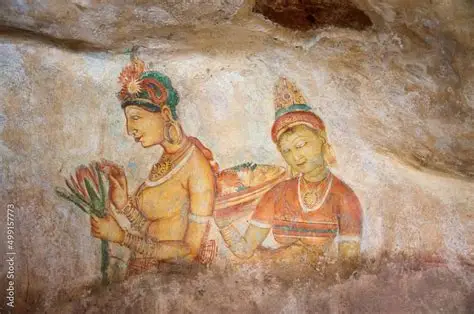
Roughly halfway up the rock, a spiral staircase leads to a sheltered gallery containing Sigiriya’s most famous artworks — a series of frescoes depicting women, traditionally known as the “Sigiriya Maidens” or “Cloud Maidens.” Originally, as many as 500 figures may have adorned the rock face, but today only about 22 survive. They remain vivid and remarkably well-preserved after 1,500 years, their colours still rich and their expressions still captivating. Photography is permitted but flash is prohibited.
The Mirror Wall
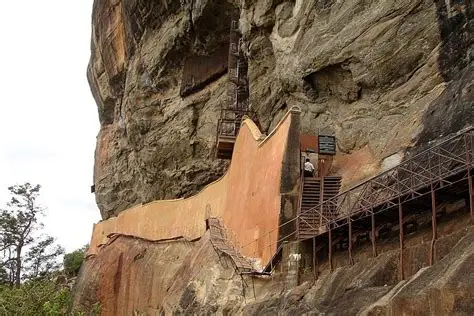
Below the fresco gallery, a long stone wall was originally polished to a mirror-like shine — so smooth that the king could see his reflection as he walked along it. Over the centuries, visitors inscribed verses, comments, and graffiti on the wall, some dating back to the eighth century. These inscriptions are among the oldest surviving examples of Sinhalese poetry and prose, and scholars continue to study them for insights into the language and attitudes of the time.
The Lion's Paw Gateway
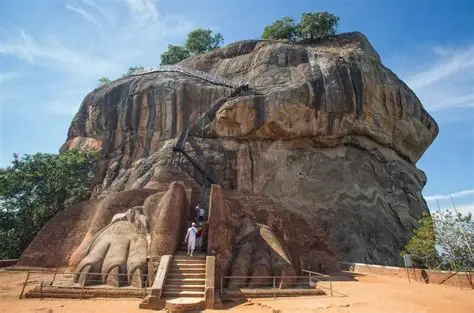
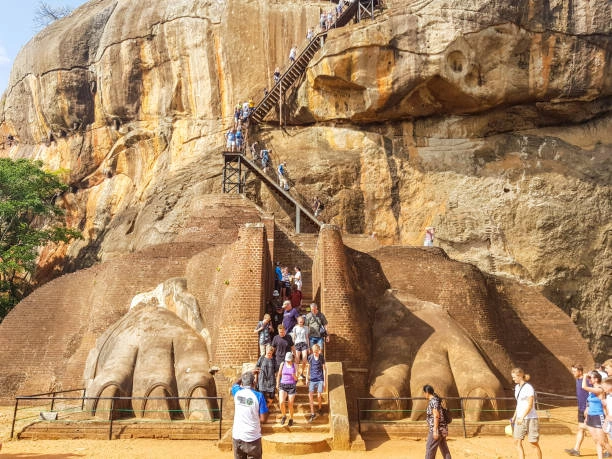
The most dramatic moment of the climb arrives at the northern face of the rock, where a broad terrace holds the remains of a colossal lion gateway. Only the enormous brick paws survive today, but originally the final ascent to the summit passed through the open mouth of a full lion figure — a statement of royal power designed to awe and intimidate. The name “Sigiriya” itself derives from “Sinhagiri,” meaning “Lion Rock.” From here, steep metal staircases bolted to the rock face lead to the summit.
The Summit Palace
The flat summit plateau is surprisingly large — roughly 1.6 hectares — and contains the foundations of Kashyapa’s royal palace, a throne platform, a swimming pool carved from solid rock, and several smaller structures. While little remains above ground level, the layout is clearly visible and the scale is impressive. But it is the view that steals the show — an uninterrupted 360-degree panorama of dense jungle, distant mountains, and ancient reservoirs stretching to every horizon. On clear days, you can see all the way to the central highlands.
The summit gets very hot after 10:00 AM with no shade. Bring water, sunscreen, and a hat. Arrive early to enjoy the top before the heat builds and the crowds arrive.
Peacock Lanka Travels
Pidurangala Rock — The Secret Viewpoint
For many photographers and experienced travellers, the best view of Sigiriya is not from the top — it is from the neighbouring rock of Pidurangala, about twenty minutes north. The hike to Pidurangala’s summit takes roughly 30–40 minutes through forest and across large boulders, and the reward is the classic postcard shot of Sigiriya Rock rising from the jungle canopy, backlit by sunrise. The entrance fee is a fraction of Sigiriya’s, the climb is less crowded, and the view is arguably more spectacular.
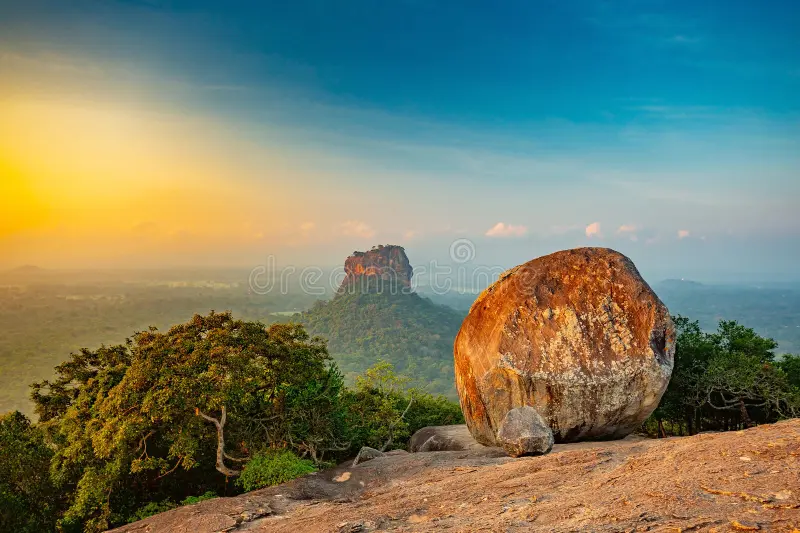
For the ultimate experience, climb Pidurangala for sunrise (arrive by 5:30 AM), then head to Sigiriya when the gates open at 7:00 AM. You get the best photograph AND the full Sigiriya experience in a single morning.
Peacock Lanka Travels
Best Time to Visit Sigiriya
Sigiriya is open year-round and can be visited in any season. The most comfortable climbing conditions are during the cooler months from November to February. The dry zone heat peaks from March to May, when the exposed rock and summit become intensely hot — early morning visits are essential during these months. The monsoon months bring occasional rain showers but also lush green landscapes and the functioning water gardens, which add a special dimension to the visit.
Practical Visitor Information
- Entry fee: Approximately USD 30 per person (or included in the Combined Cultural Triangle ticket at USD 50)
- Opening hours: 7:00 AM to 5:30 PM (last entry 5:00 PM)
- Time needed: 2.5–3.5 hours for the full climb, summit exploration, and descent
- Fitness level: Moderate — the climb is not technical but involves 1,200 steps and some steep sections
- What to bring: Water (at least 1 litre), sunscreen, hat, comfortable shoes with grip, camera
- Dress code: No specific requirements, but lightweight, breathable clothing is advisable
- From Colombo: 4–5 hours by road (170 km northeast)
- From Kandy: 2.5–3 hours by road
- From Dambulla: Just 20 minutes — almost always paired together
- Best climbing time: Gates open at 7:00 AM — arrive at opening for the coolest temperatures and thinnest crowds
- Hornets: Occasionally nesting on the rock face. Guides will warn you about active nests — stay quiet and move steadily if you pass one
Sigiriya Museum
Before or after your climb, visit the small but excellent Sigiriya Museum near the main entrance. The exhibits provide context about the rock’s history, construction techniques, and the civilisation that built it. Scale models, archaeological finds, and informative panels help you understand the full significance of what you have seen — or are about to see. Allow 30–45 minutes.
Nearby Attractions to Combine
- Dambulla Cave Temple — 20 minutes away; five ancient caves with extraordinary painted ceilings (UNESCO)
- Polonnaruwa Ancient City — 1.5 hours; medieval ruins best explored by bicycle (UNESCO)
- Minneriya National Park — 45 minutes; famous for the dry-season elephant gathering (July–October)
- Kaudulla National Park — 1 hour; an alternative elephant safari destination
- Habarana — 30 minutes; a central base for the Cultural Triangle with village walks and lake safaris
Visit Sigiriya with Peacock Lanka Travels
Sigiriya is the centrepiece of every Cultural Triangle itinerary we design. We time your visit for the optimal climbing window, arrange expert guides who bring the history alive, and pair the climb with Dambulla, Polonnaruwa, or an afternoon elephant safari for a perfectly balanced day. Whether you are spending one day in the Cultural Triangle or three, Sigiriya is always the highlight.
Contact Peacock Lanka Travels today and let us create your perfect Sri Lanka tour package tailored to your interests, budget, and travel style.

Ready to Explore?
+94 70 777 7776